
What SPF Testing Really Tells You (And What the Label Leaves Out)
"Understanding how sunscreen is tested gives you a foundation. Understanding what the label is actually showing you is the next step, and it is more complicated than most people realise."
In our previous article, we covered how sunscreen is tested: what SPF actually measures, the difference between in vivo and in vitro methods, and why both are mandatory in the UK and EU under ISO 24444 and ISO 24443, respectively.
That testing framework tells you something important: when a sunscreen reaches the shelf, its SPF and UVA protection claims have been verified through established methods under regulatory oversight.
What it does not tell you is what is inside the formula. And that is where things get more interesting because reading a sunscreen ingredient list requires more knowledge than most labels make obvious.
What the two testing methods actually confirm
It is worth briefly recapping what each mandatory test confirms, because this shapes how you interpret the rest of the label.
In vivo testing, conducted on real human skin under controlled UV exposure (ISO 24444), determines the SPF rating you see on the bottle. It confirms that the formula, when applied to actual skin, delivers the UVB protection stated on the label.
In vitro testing, conducted in a laboratory setting (ISO 24443), confirms UVA protection. It measures how the formula filters the longer UVA wavelengths that penetrate deeper into the skin and contribute to premature ageing.
Together, they answer one question reliably: Does this product filter UV radiation at the level claimed?
What they do not address is the nature of the UV filter being used to achieve that protection, or how it is listed on the ingredient label.

"The testing tells you that sunscreen works. The label tells you what it uses to do so. Those are two separate questions, and the second one takes a little more reading."
What the label is actually showing you
Sunscreen ingredient lists follow the INCI standard: International Nomenclature of Cosmetic Ingredients. This system applies across the UK, EU, and most global markets, and it means every ingredient is listed using its standardised scientific name, not the common or trade name most consumers are familiar with.
For most cosmetic ingredients, this is a minor detail. For UV filters, it creates a genuine gap between what people are looking for and what they find.
THE NAMING GAP
Some of the most widely discussed chemical UV filters appear on labels under names that bear no obvious resemblance to what most people know them as. If you are trying to identify whether a specific filter is present, you may need to know both names.

COMMON CHEMICAL UV FILTERS AND HOW THEY APPEAR ON UK / EU LABELS
|
Common name |
INCI name on UK / EU label |
Filter type |
|
Avobenzone |
Butyl Methoxydibenzoylmethane |
UVA |
|
Oxybenzone |
Benzophenone-3 |
UVA / UVB |
|
Octinoxate |
Ethylhexyl Methoxycinnamate |
UVB |
|
Octocrylene |
Octocrylene |
UVA / UVB |
Note: In the United States, sunscreens are regulated as over-the-counter drugs, and active UV filters must appear in a separate Drug Facts panel using their common names. Outside the US, INCI names apply.
This matters most when you are actively trying to avoid a particular ingredient. A product can be entirely free of "Avobenzone" in the common-name sense whilst listing "Butyl Methoxydibenzoylmethane" on the label. They are the same thing.
NEWER-GENERATION FILTERS AND NATURALLY POSITIONED PRODUCTS
Beyond the well-established filters above, a newer generation of chemical UV filters has become more widely used, including in some products positioned as natural, botanical, or clean. These filters are approved under EU cosmetics regulation, and many have strong safety profiles based on current data. But they are still chemical UV filters, and they are not always easy to identify by name alone.
Two worth being aware of are:
- Diethylhexyl Butamido Triazone, a UVB filter, is also known by the trade name Uvasorb HEB. It is approved in the EU at up to 10% concentration. Current safety assessments do not flag significant concerns around skin penetration or endocrine disruption.
- Diethylamino Hydroxybenzoyl Hexyl Benzoate (DHHB), a UVA filter, is also known as Uvinul A Plus. It is approved in the EU at up to 10% concentration. This is the filter currently subject to active regulatory review, discussed below.
You may also see Tinosorb S and Tinosorb M listed by their INCI names:
-
Bis-Ethylhexyloxyphenol Methoxyphenyl Triazine (Tinosorb S), a broad-spectrum UVA/UVB filter
-
Methylene Bis-Benzotriazolyl Tetramethylbutylphenol (Tinosorb M), a broad-spectrum UVA/UVB filter
These longer, less familiar names are one reason consumers looking for clean or minimal formulations can find label-reading genuinely difficult, even in good faith.
Active regulatory discussion · DHHB (Diethylamino Hydroxybenzoyl Hexyl Benzoate)
In 2024, German authorities detected elevated levels of mono-n-hexyl phthalate (MnHexP) in urine samples from children. MnHexP is a breakdown product of di-n-hexyl phthalate (DnHexP), a plasticiser that has been prohibited in cosmetics since 2013. Investigations linked the likely source to DHHB, a UVA filter used in some sunscreens, which can contain DnHexP as a manufacturing impurity.
As of 2025, the EU's Scientific Committee on Consumer Safety (SCCS) has issued a final opinion setting a maximum safe level of 0.026% for the DnHexP impurity within DHHB formulations. The regulatory conversation is ongoing.
For full context, the Euro Cosmetics review of this developing situation is available at eurocosmetics-mag.com.
A practical approach to reading the label
You do not need to memorise every UV filter name. A few straightforward questions will tell you most of what you need to know:
What to look for
-
Look at the active UV filter. If the label lists Zinc Oxide or Titanium Dioxide as the UV filter, the product uses mineral protection. These are the only two UV filters currently classified as generally recognised as safe and effective (GRASE) by the US FDA, and both are approved in the UK and EU.
-
Look for chemical-sounding names in a "natural" product. If a product is marketed as natural or botanical but the ingredient list includes long chemical names such as those listed above, those are organic (chemical) UV filters, regardless of how the product is positioned.
-
Use the US label as a cross-reference. If a brand sells in the US, its American packaging must list active sunscreen ingredients using their common names in a Drug Facts panel. This can be a useful reference when comparing UK or EU labels.
The INCI naming system applies across the UK, EU, and most global markets. Australia uses the same convention.
Our approach at Baie Botanique
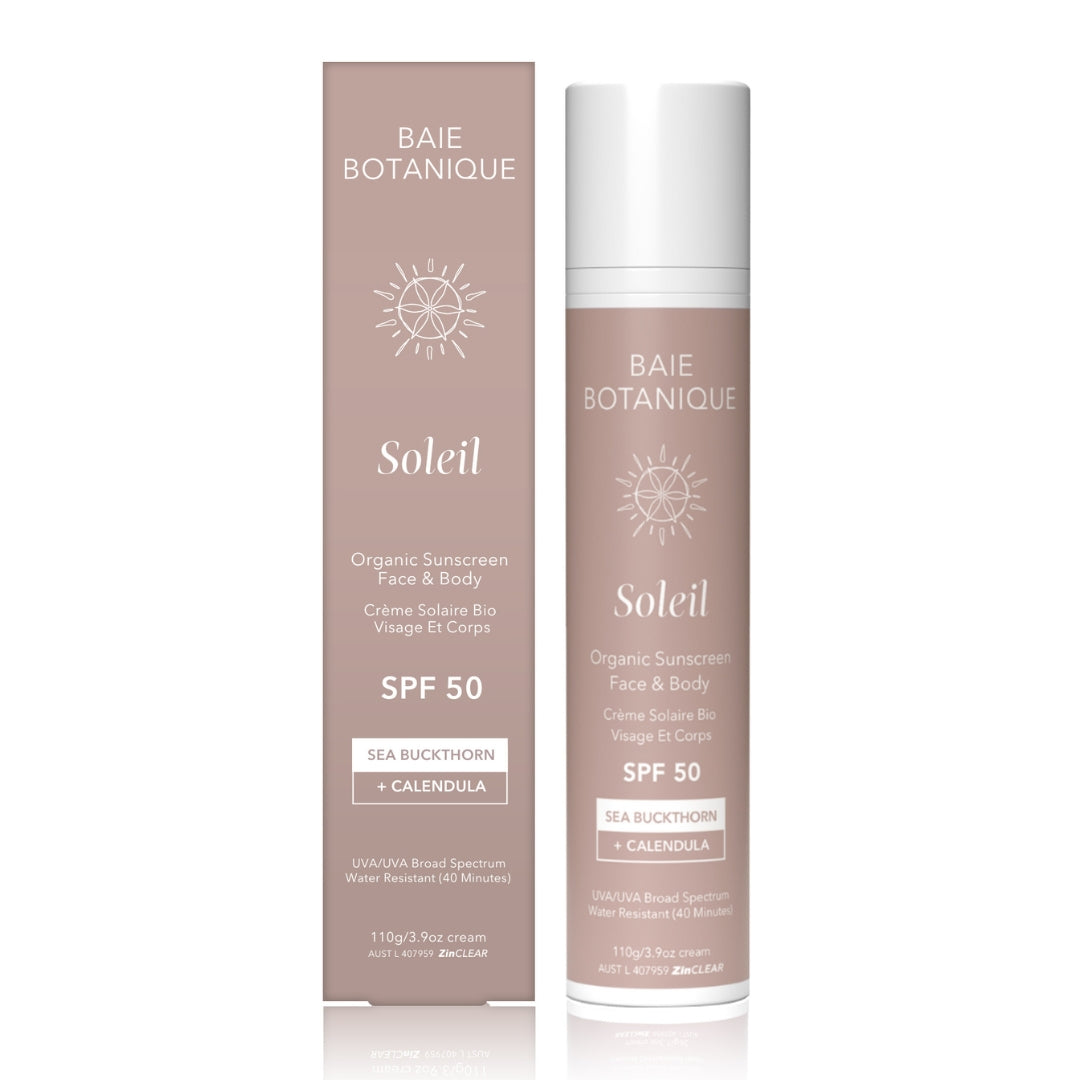
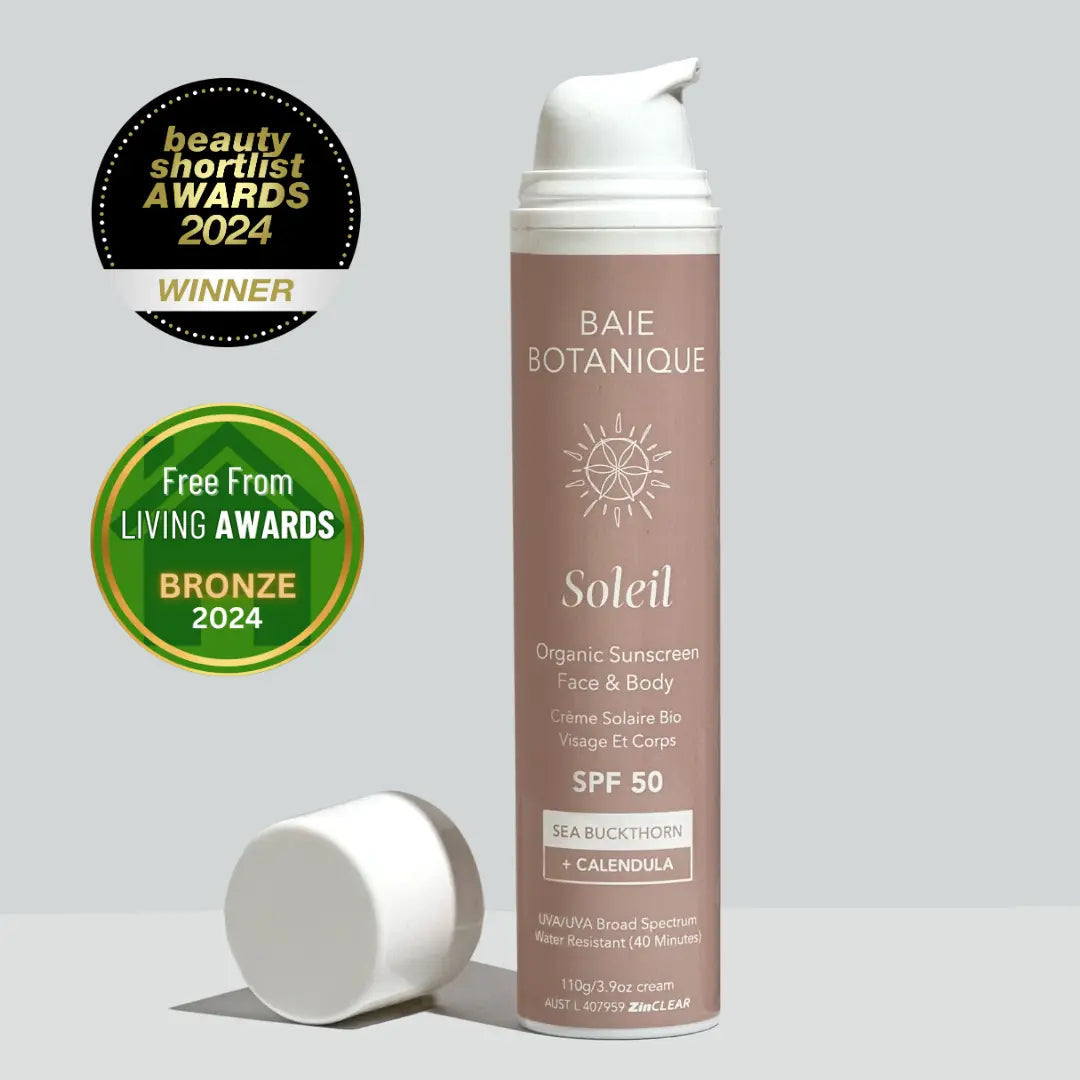
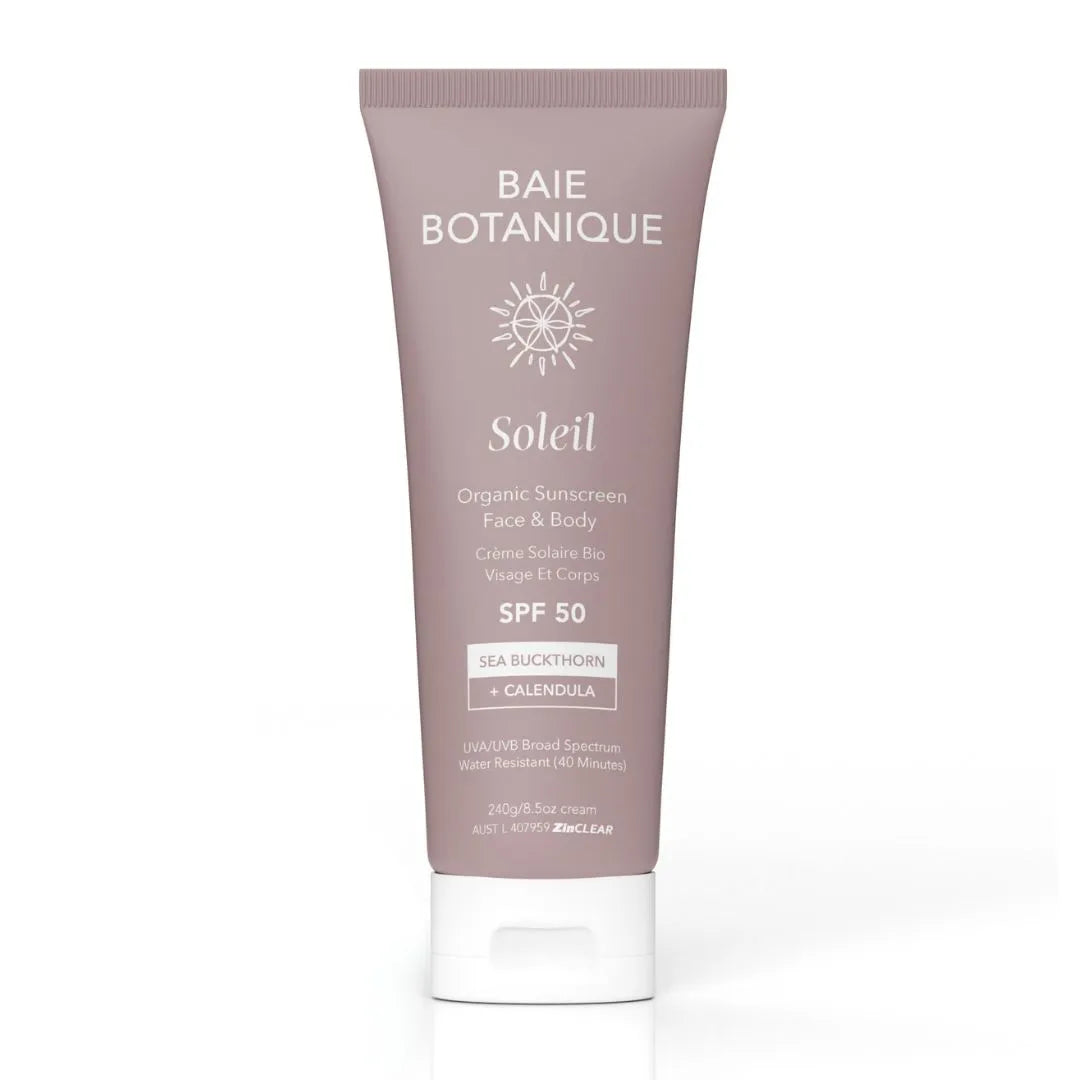
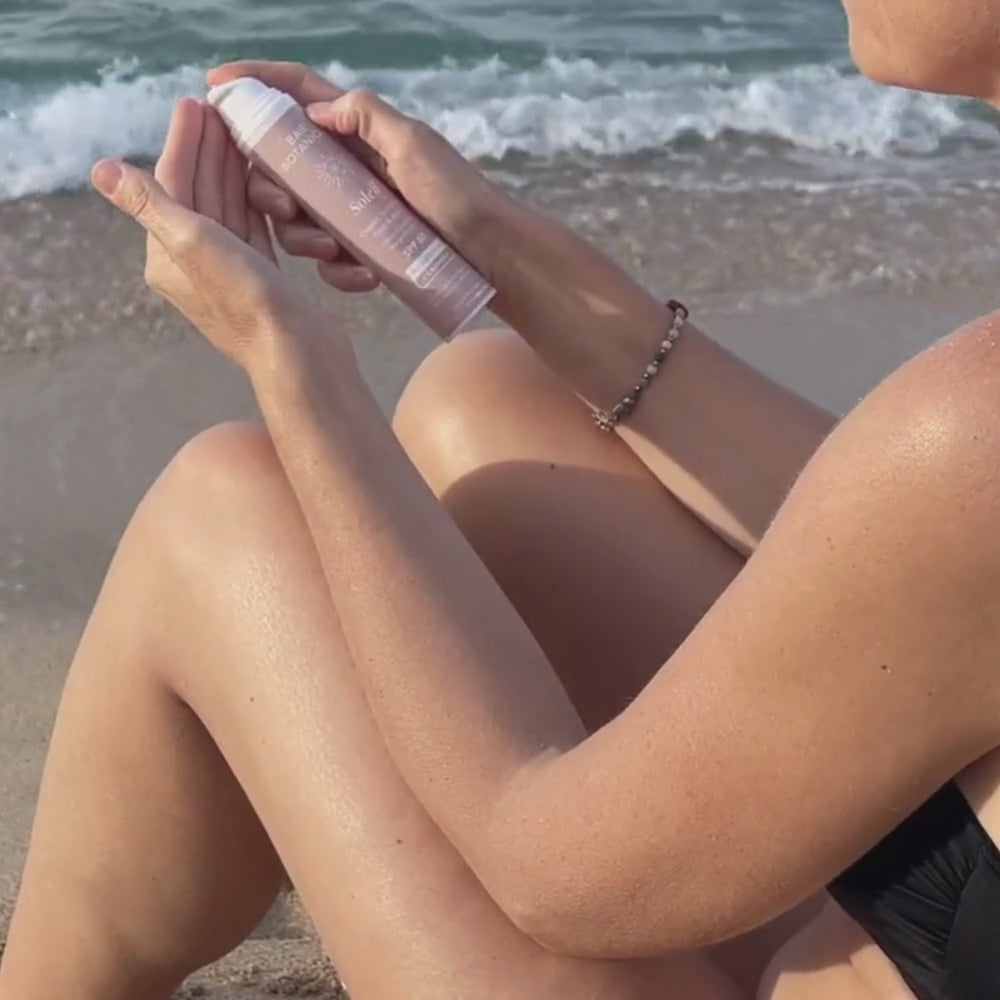
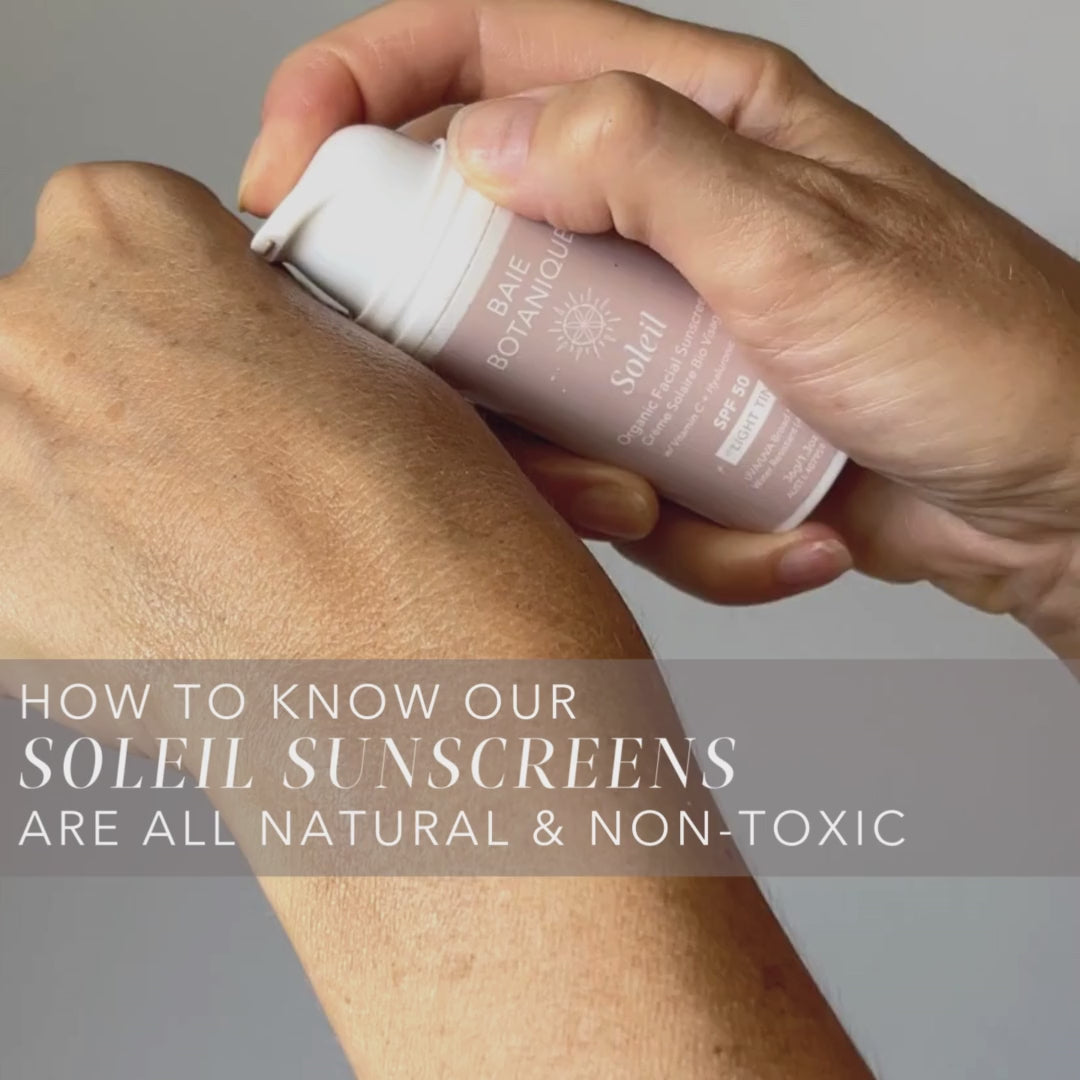
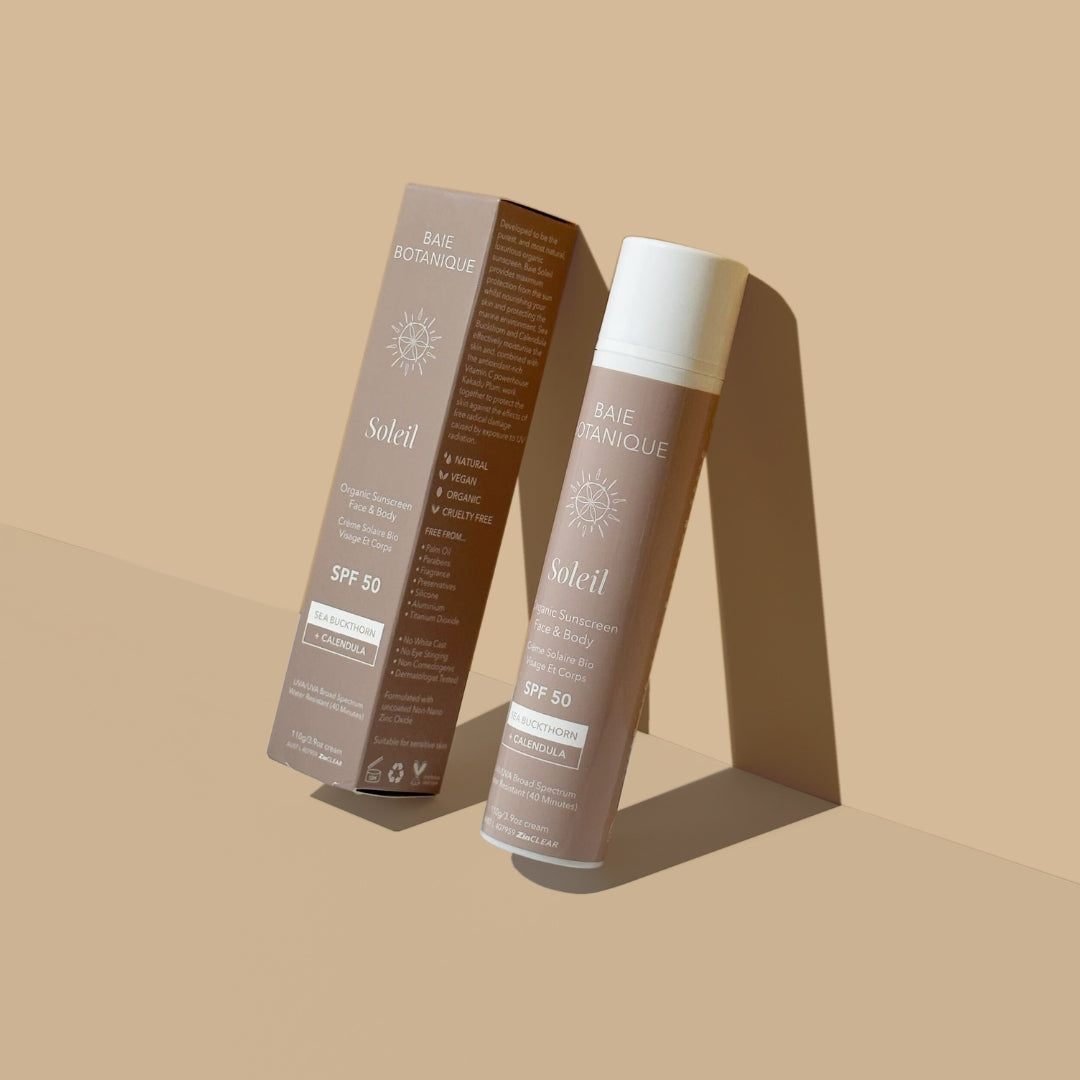
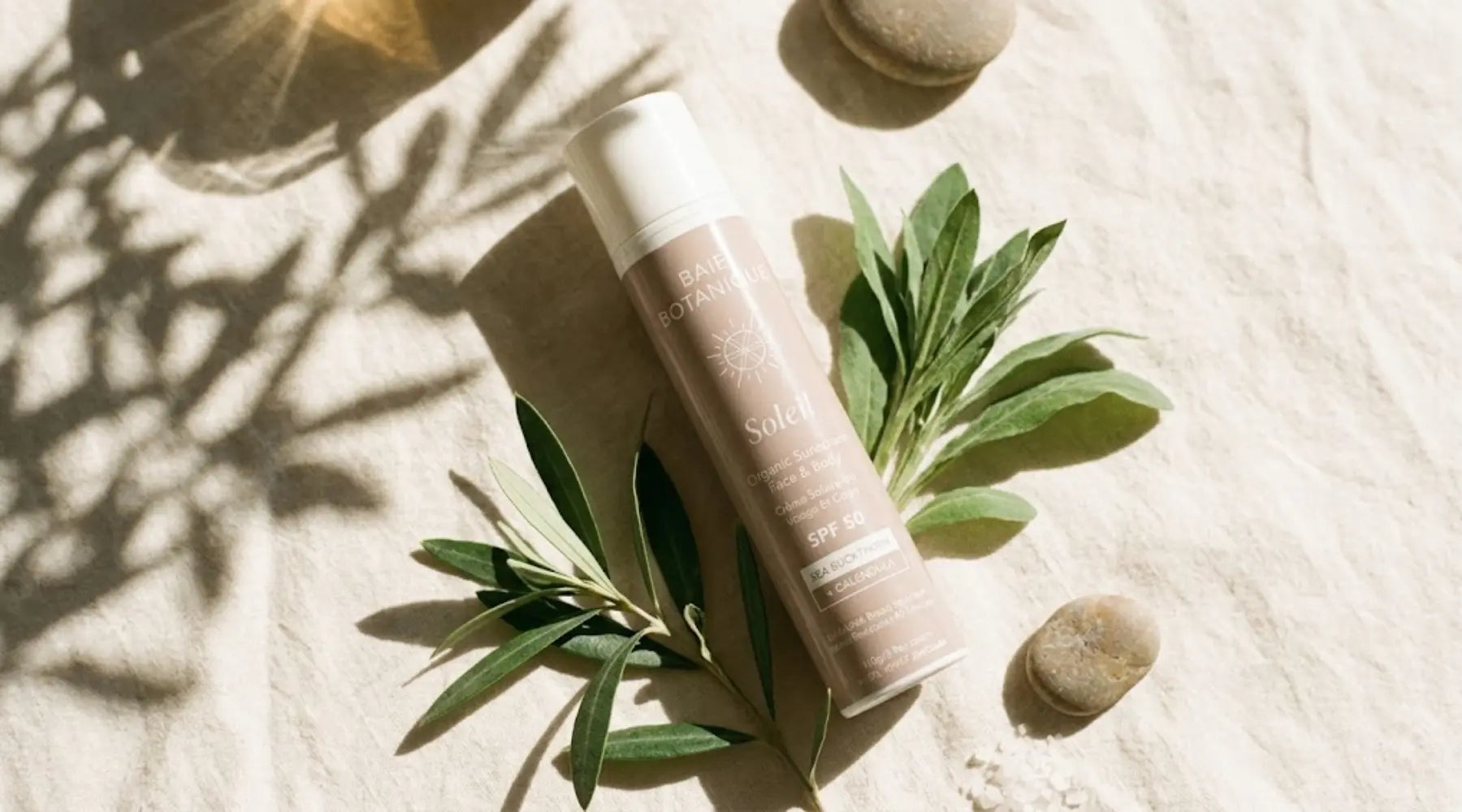
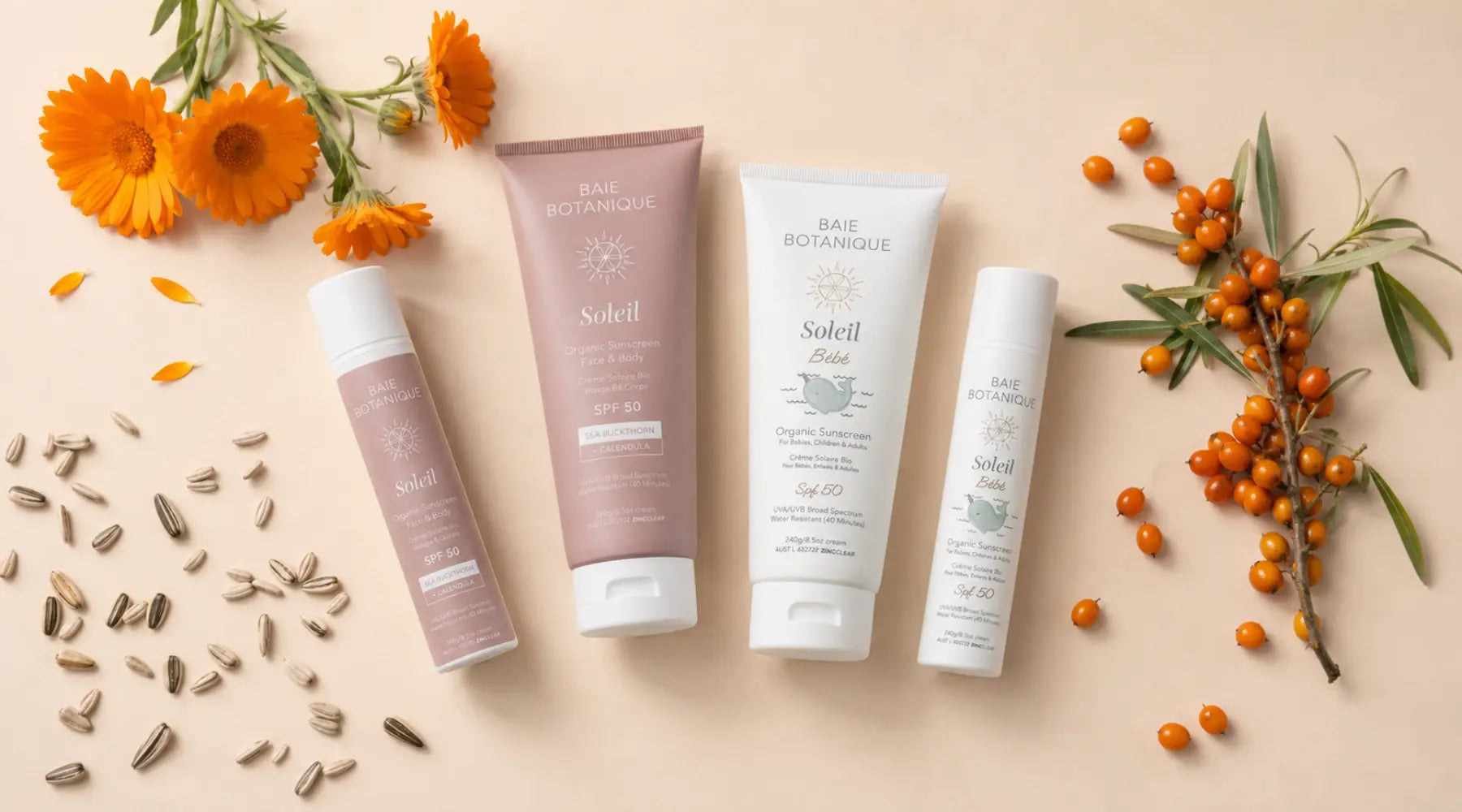
At Baie Botanique, the Soleil Performance Suncare range uses 100% non-nano zinc oxide as the only UV filter across every product in the range. No chemical UV filters. No hybrid formulations. No ingredients that require you to know two names to recognise what you are using.
We also made the decision not to use titanium dioxide. Although it remains an approved mineral UV filter, some consumers prefer to avoid it due to ongoing debate and health concerns surrounding titanium dioxide in certain applications. We therefore chose to formulate the Soleil range exclusively with non-nano zinc oxide as our single mineral UV filter.
For us, that consistency is part of the formulation principle, not an afterthought. When you apply sunscreen generously and repeatedly, which is the only way it works properly, you should be able to do so without having to second-guess the ingredient list.
Final thoughts
Both testing methods required in the UK and EU, in vivo for SPF, in vitro for UVA protection, serve an important purpose. They confirm that sunscreen delivers the protection it claims.
What they do not resolve is which ingredients are used to achieve that protection, or whether those ingredients are easy to identify on the label. That is a separate conversation, and one that requires a little more knowledge to navigate confidently.
Understanding the naming conventions, the difference between established and newer-generation filters, and what to look for on a UK or EU label is a practical step towards making more considered choices for yourself and your family.
Sources
- ISO 24444:2019/Amd.1:2022. Cosmetics — Sun protection test methods — In vivo determination of the sun protection factor (SPF).
- ISO 24443:2021. Cosmetics — Sun protection test methods — In vitro determination of sunscreen UVA photoprotection.
- European Commission. Cosmetics Regulation (EC) No 1223/2009 — Annex VI UV filters.
- British Association of Dermatologists. Sun protection and sunscreen guidelines.
- SpecialChem Cosmetics. (2025). INCI: Butyl Methoxydibenzoylmethane (Avobenzone). specialchem.com
- Wikipedia. (2025). Avobenzone. en.wikipedia.org/wiki/Avobenzone
- Wikipedia. (2025). Oxybenzone. en.wikipedia.org/wiki/Oxybenzone
- INCIDecoder. (2025). Diethylhexyl Butamido Triazone. incidecoder.com
- ChemLinked. (2024). EU SCCS Drafts Opinion on the UV Filter DHHB. cosmetic.chemlinked.com
- REACH24H. (2025). EU SCCS Issues 2025 Final Opinions on EHMC, DHHB, BP-1, BP-2, and BP-5. reach24h.com
- Euro Cosmetics. (2024). Plasticiser in children's urine: are we about to lose another UV filter? eurocosmetics-mag.com
- Wikipedia. (2025). Bemotrizinol (Tinosorb S). en.wikipedia.org/wiki/Bemotrizinol
- Wikipedia. (2025). Bisoctrizole (Tinosorb M). en.wikipedia.org/wiki/Bisoctrizole